Auralis

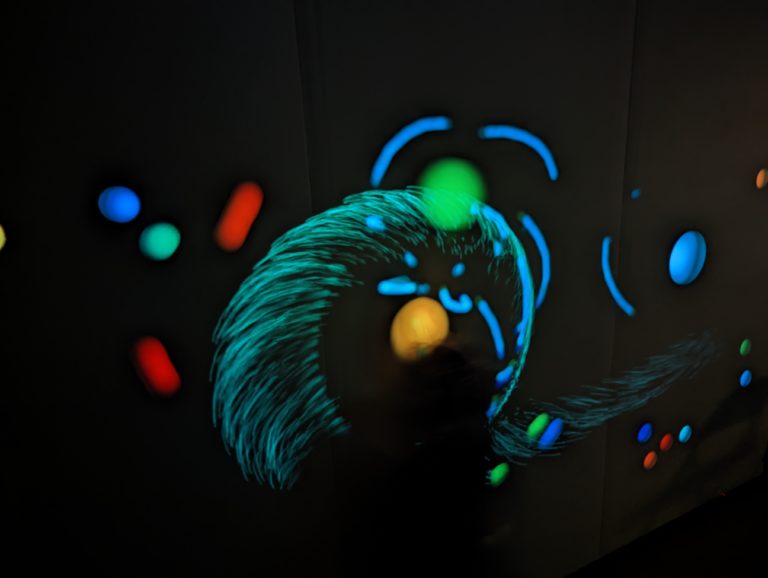
Auralis is a musical instrument constructed from a multitouch table and custom software ported from my earlier touch wall Touch #2. Merging sound, interactivity, and sequencing, Auralis is simultaneously engaging, meditative and soothing. I created the work for youth ages 8-14.

A virtual world of suns, stars and planets interact with each other. Participants run their fingers across the display to create new forces. As each planet has its own pitch, a series of planets encircling a virtual sun can be played as a musical sequence.

Auralis. Please play video with sound on.

Auralis was built from a hacked SmartTable 442i with upgraded OPS i7 11th generation computer module running Windows 10.

Software is written in Pure Data (Pd) and makes heavy use of Pd library pmpd. Multitouch support was created with a custom C# application which sends OSC messages to Pd using sockets. The C# application captured touch events using SmartTech’s multitouch SDK.

Auralis is a portable installation that is currently available to any organizations that might be interested.
Similar Posts

  • SoundScratch

    SoundScratch is a set of extensions I wrote to manipulate audio in a children’s programming language called Scratch. The environment emphasizes the expressive capabilities of sound through the act of creation and design.

  • SoundBlocks

    SoundBlocks is a tangible environment where youth connect blocks to describe network dataflow. The environment explores digital sound manipulation as a personal, meaningful and fun artistic endeavor, rather than as a venture into mathematical, electronic or networking relationships.

  • Cybergarden

    As part of Wichita’s Open Studios project, TechArtICT opened Cybergarden at Towne West Mall. Cybergarden was “a magical space…a mysterious metaverse.” It featured work from various artists and creatives in the greater Wichita area. TechArtICT was founded by me and many of my works were featured in the installation, including Ghost in the Machine and…

  • Microphone with proximity detection

    Around 2004 I developed a few protoype microphones enhanced to also offer proximity detection. The microphone could adjust it’s amplitude and bass response based on the proximity of the person using it. This would lessen the variable results users experience when holding a microphone too close or too far. Moreover, with proximity or its derivative mapped to a combination…

  • Be The Shortstop!

    Be The Shortstop! is a permanent public indoor installation at The Baseball Museum in Riverfront Stadium, Wichita KS. Players hit a large button on a kiosk to start the game. After a few seconds the game starts as they race to hit the correct button on a large wall. A crowd cheers on speakers as…