Ghost in the Machine

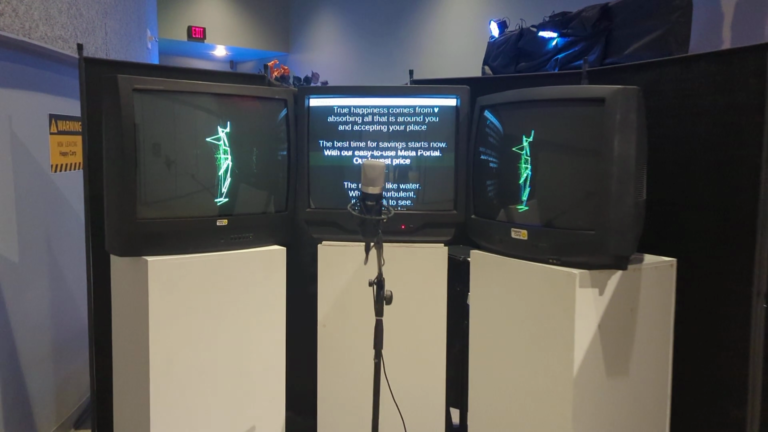
Ghost in the Machine. Cybergarden@Towne West Mall, May 2022

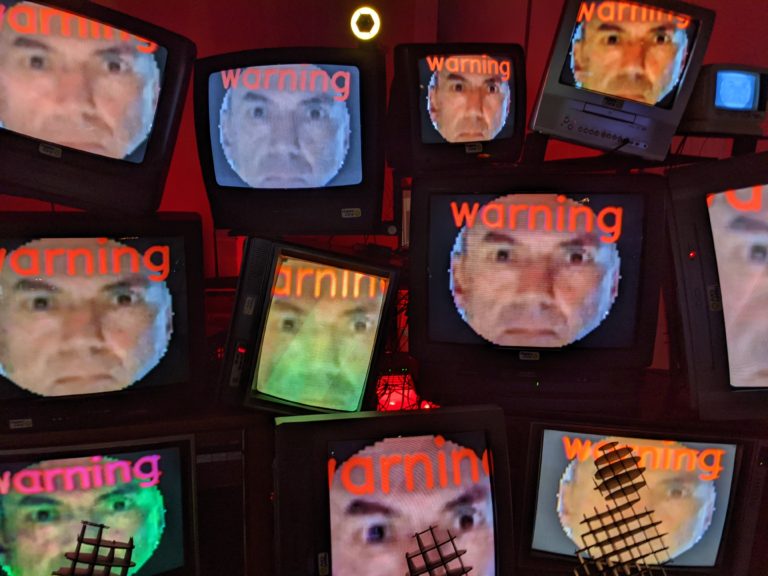
Originally conceived in 2008, Ghost in the Machine (GITM) consists of a webcam and display which mixes and crossfades events in realtime with motion-activated video it has recorded previously. It continually shifts between 3 states: individual, community, and the world.

GITM has been shown in many venues and contexts.
Similar Posts

  • Minigolf at Figment in New York

    As a faculty member Wichita State University’s College of Engineering (WSU), I worked with students to create and install a mini-golf hole as part of FIGMENT at Governor’s Island, NY in 2010. I also gave the keynote address that year for FIGMENT’s public art opening. WSU’s mini-golf hole was chosen from a juried selection. Our…

  • SoundBlocks

    SoundBlocks is a tangible environment where youth connect blocks to describe network dataflow. The environment explores digital sound manipulation as a personal, meaningful and fun artistic endeavor, rather than as a venture into mathematical, electronic or networking relationships.

  • TV Mountain

    TV Mountain is an art piece which was initially installed as part of TechArtICT’s Dreamgrass installation at Exploration Place Fall 2022. It consisted of 12 TVs at various angles and orientations, together forming a jumbotron. As part of Dreamgrass, it subjected faceless child-like objects to a litany of 80s commercials. The working remote enjoyed a…

  • LegalLanguage

    I wrote LegalLanguage, a scripting language for lawyers at Legal Services Corporation in West Virginia. The staff used LegalLanguage to write simple scripts that could then ask clients questions, give guidance, and print out the appropriate forms. This freed up resources to focus on the large number of cases involving domestic violence.

  • SoundScratch

    SoundScratch is a set of extensions I wrote to manipulate audio in a children’s programming language called Scratch. The environment emphasizes the expressive capabilities of sound through the act of creation and design.

  • Microphone with proximity detection

    Around 2004 I developed a few protoype microphones enhanced to also offer proximity detection. The microphone could adjust it’s amplitude and bass response based on the proximity of the person using it. This would lessen the variable results users experience when holding a microphone too close or too far. Moreover, with proximity or its derivative mapped to a combination…