Chord Recognition in Beatles Songs
Chord Recognition in Beatles Songs

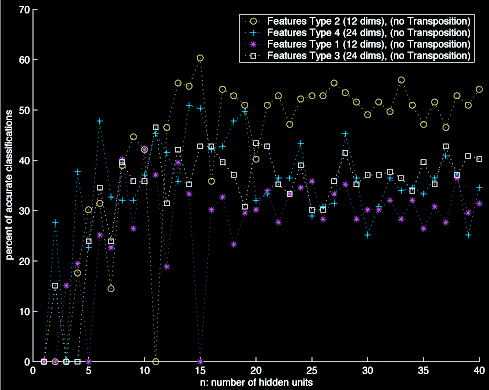
While a graduate student at MIT’s Media Lab, I collaborated with office-mate Vi­ctor Adán to explore how if we might train a machine to recognize chord changes in music. We tried multiple models to solve the problem, including Support Vector Machines, Neural Networks, Hidden Markov Models, and a few variations of Maximum Likelihood systems.

We chose Beatles tunes as a subset of the larger problem and trained our systems with 16 songs from three of their albums. Our systems processed 2700 training samples, 150 validation samples, and 246 testing samples. Our most successful system, a Support Vector Machine, achieved 68% accuracy in testing.

Our intention was to further the research which will lead to applications such as automatic transcription, live tracking for improvisation, and computer-assisted (synthetic) performers. Our models were an extension of the research provided by the following papers:

  • Musical Key Extraction from Audio, Steffen Pauws
  • Chord Segmentation and Recognition using EM-Trained Hidden Markov Models, Alexander Sheh and Daniel P.W. Ellis
  • SmartMusicKIOSK: Music Listening Station with Chorus-Search Function, Masataka Goto
  • A Chorus-Section Detecting Method for Musical Audio Signals, Masataka Goto
Main Website

Similar Posts

  • DoubleTalk

    Doubletalk, a two player audio-manipulation game was my first serious endeaver with the Gameboy. The game used the Pocketvoice, a Gameboy cartridge with a built-in amplified speaker and microphone. In Doubletalk, players record themselves, reverse their recordings, then try to guess what each other is saying.

  • Be The Shortstop!

    Be The Shortstop! is a permanent public indoor installation at The Baseball Museum in Riverfront Stadium, Wichita KS. Players hit a large button on a kiosk to start the game. After a few seconds the game starts as they race to hit the correct button on a large wall. A crowd cheers on speakers as…

  • Microphone with proximity detection

    Around 2004 I developed a few protoype microphones enhanced to also offer proximity detection. The microphone could adjust it’s amplitude and bass response based on the proximity of the person using it. This would lessen the variable results users experience when holding a microphone too close or too far. Moreover, with proximity or its derivative mapped to a combination…

  • TechArtICT: Whispering Woodlands

    Whispering Woodlands was an outdoor installation created by TechArtICT. It was installed at Exploration Place in Wichita, Kansas from November 2023 through January 2024. The work featured 24 independently controlled sets of speakers and LEDs, all synchronized to create an immersive sound and lightscape. Using eclectic audio ranging from thunder and rain to spaceships and…

  • SoundScratch

    SoundScratch is a set of extensions I wrote to manipulate audio in a children’s programming language called Scratch. The environment emphasizes the expressive capabilities of sound through the act of creation and design.