In the Spring of 2008 I taught Wichita State University’s Assembly Language Programming for Engineers course. As explained in the syllabus, the course used the Z80 microprocessor and the GameBoy platform to introduce general concepts of computer architecture, machine and assembly language programming. Students practiced the ideas and concepts introduced in the course with programming projects on the GameBoy. For their final project students in the course wrote a game. We then held a celebratory public event where kids of all ages could play all the games.
Similar Posts
Auralis
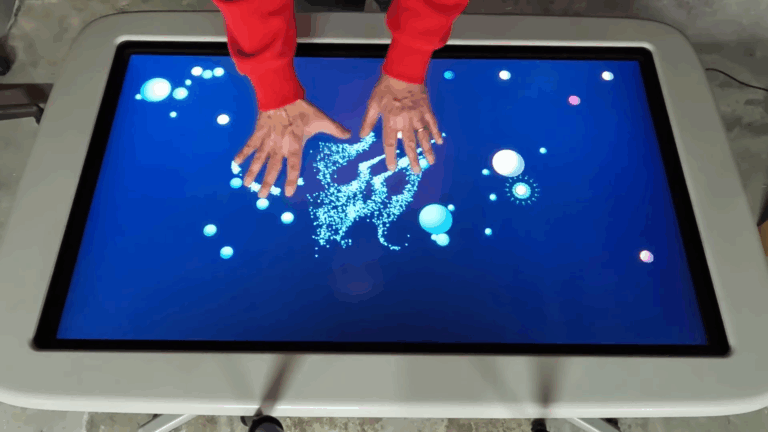
Auralis is a musical instrument constructed from a multitouch table and custom software ported from my earlier touch wall Touch #2. Merging sound, interactivity, and sequencing, Auralis is simultaneously engaging, meditative and soothing. I created the work for youth ages 8-14. A virtual world of suns, stars and planets interact with each other. Participants run…
Technology for Humankind, Filimin, and Friendship Lamps
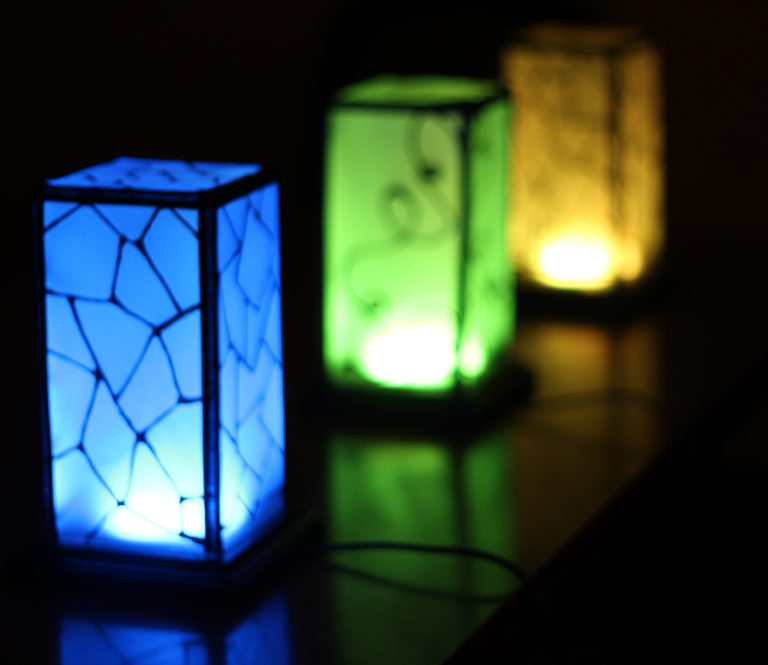
From 2015 through 2021 I was the founder and owner of Technology for Humankind DBA Filimin, makers of the Friendship Lamp. During my tenure the company grew to over 40 employees with annual revenue of over 3 million in less than 6 years. Filimin was conceived from my invention of the Friendship Lamp as a…
SoundBlocks
SoundBlocks is a tangible environment where youth connect blocks to describe network dataflow. The environment explores digital sound manipulation as a personal, meaningful and fun artistic endeavor, rather than as a venture into mathematical, electronic or networking relationships.
Microphone with proximity detection
Around 2004 I developed a few protoype microphones enhanced to also offer proximity detection. The microphone could adjust it’s amplitude and bass response based on the proximity of the person using it. This would lessen the variable results users experience when holding a microphone too close or too far. Moreover, with proximity or its derivative mapped to a combination…
Strings, Kansas!
In fall 2006 I launched an initiative at WSU called Strings, Kansas! A distance-learning-enhanced program, Strings, Kansas! connected WSU School of Music string students with 4th and 5th graders in communities without string programs. WSU string students created, designed, and implemented the curriculum for the 4th and 5th graders.
Introduction to Audio and Video Synthesis
I taught a course called Introduction to Audio and Video Synthesis which introduced a variety of classic synthesis techniques, digital signal processing, and audio production. Additionally, students were exposed to important class and contemporary electronic works.