Ballet Wichita: Innovations

As part of the Ballet Wichita’s Innovations performance April 2024 I teamed up with Wichita State University’s Shocker Studios to track a dancer live, reinterpreting their motions on a stage-sized display behind them. Wichita State University’s Fairmount String Trio accompanied the dance, performing Dohnányi’s Serenade.
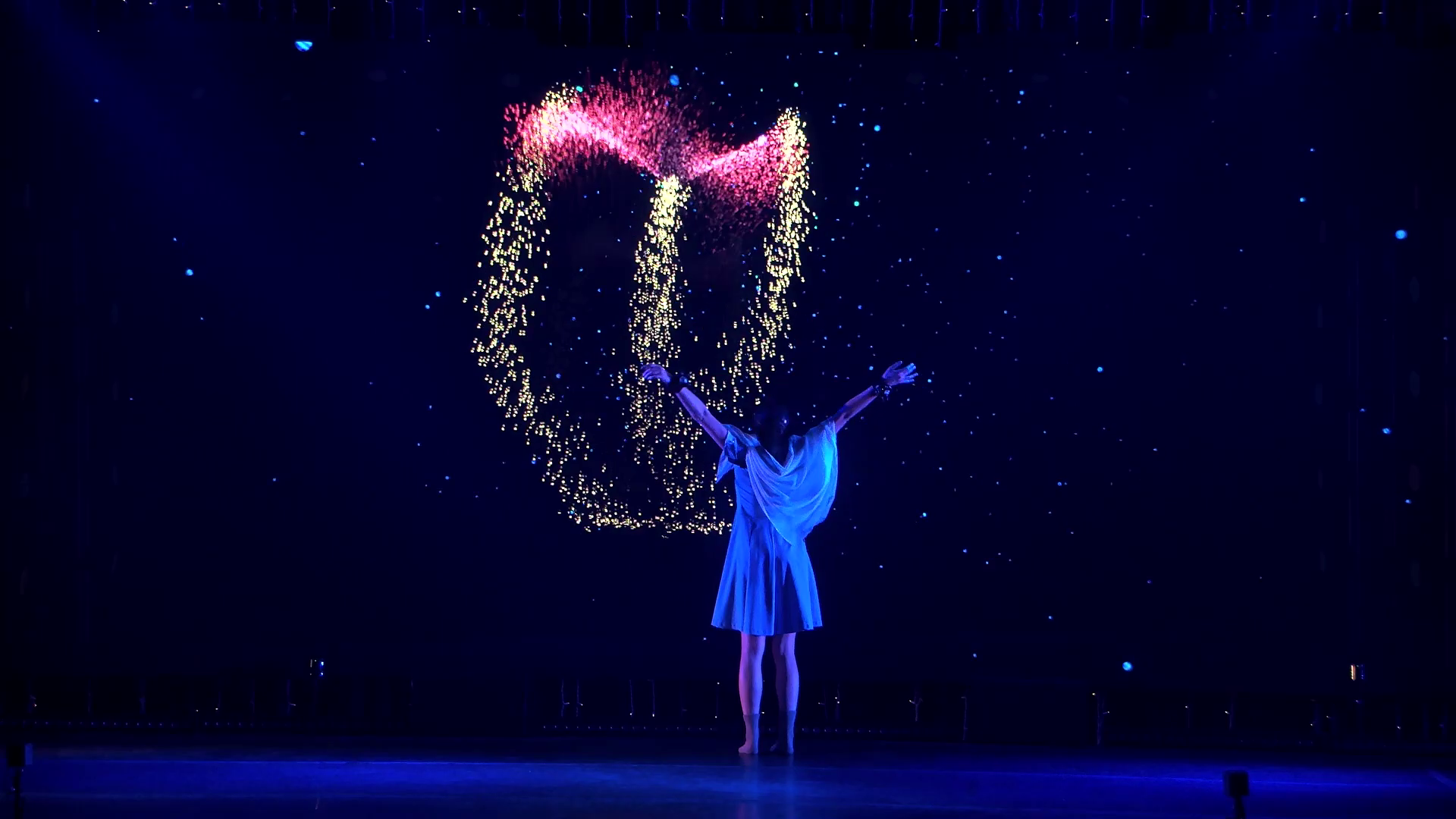
To track the dancer we used 3 Vive 3.0 trackers paired with 4 Vive 2.0 base stations. We then interfaced Unreal Engine 5.3 to the trackers and mapped them to Unreal’s Niagara particle system.

Danni Varenhorst dances as part of Innovations

Brian Foster did the bulk of the heavy lifting building the Niagara system in Unreal Engine. After the project ended, he further developed the technical aspects of this work by tracking dancers in Shocker Studios’ motion capture lab and expanding his use of Unreal’s Niagara particle system.
Read more about Innovations

Similar Posts

  • Have a Seat!

    Have a Seat! is a playful interactive installation in which a video of a traveler of both time and space urges viewers to sit on a couch. When three people sit close together on the couch a special broadcast or snippet of The Muppet Show plays. Strangers coming to view the work find themselves uncomfortably…

  • Ghost in the Machine

    Originally conceived in 2008, Ghost in the Machine (GITM) consists of a webcam and display which mixes and crossfades events in realtime with motion-activated video it has recorded previously. It continually shifts between 3 states: individual, community, and the world. GITM has been shown in many venues and contexts.

  • Digital Puppetry

    I worked with a team of colleagues, community members, and urban youth. Our intention was to help the youth learn in a playful environment, find personal self-expression, and have their voices heard by communities in Boston. To do this, we adapted commercially available technology to provide a unique medium: digital puppetry.

  • SoundScratch

    SoundScratch is a set of extensions I wrote to manipulate audio in a children’s programming language called Scratch. The environment emphasizes the expressive capabilities of sound through the act of creation and design.

  • DoubleTalk

    Doubletalk, a two player audio-manipulation game was my first serious endeaver with the Gameboy. The game used the Pocketvoice, a Gameboy cartridge with a built-in amplified speaker and microphone. In Doubletalk, players record themselves, reverse their recordings, then try to guess what each other is saying.

  • Microphone with proximity detection

    Around 2004 I developed a few protoype microphones enhanced to also offer proximity detection. The microphone could adjust it’s amplitude and bass response based on the proximity of the person using it. This would lessen the variable results users experience when holding a microphone too close or too far. Moreover, with proximity or its derivative mapped to a combination…