Touch #2

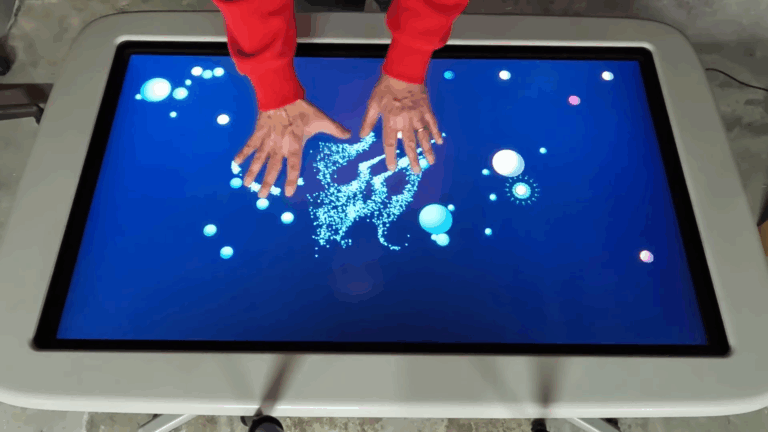
Touch #2 is a playful virtual environment and an interactive, musical instrument. Viewers become participants through play.
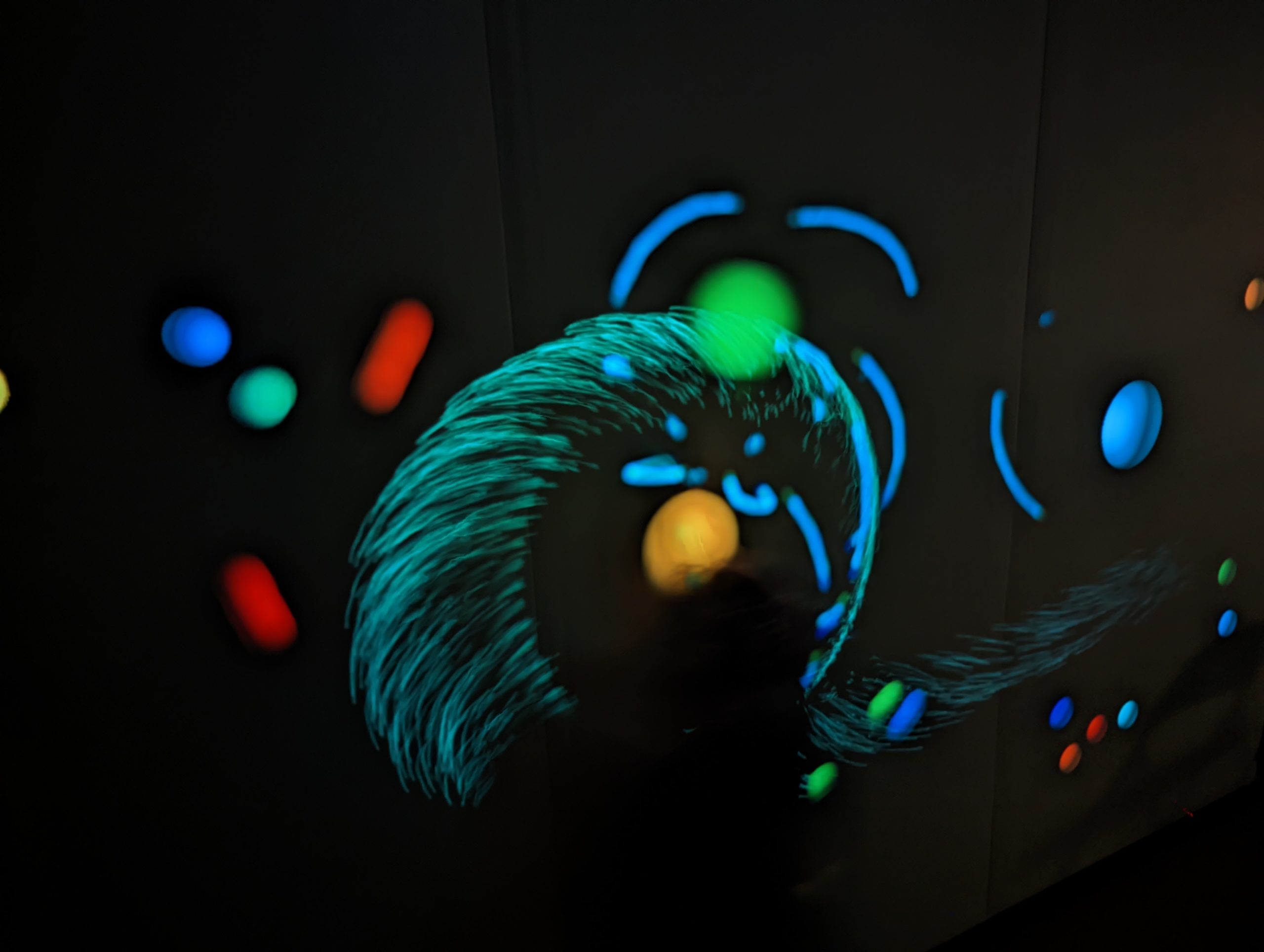
Touch #2. Cybergarden@Towne West Mall, 2022

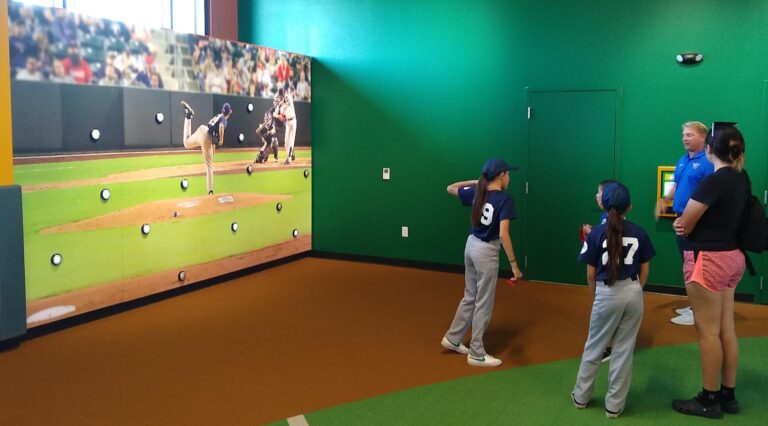
The work transforms any flat wall into a touch-sensitive surface. A projector and infrared camera mount on the ceiling and infrared emitters mount on top of the wall, allowing the work to detect as many as 10 touches at once. A virtual environment of suns, stars and planets projects onto the wall. Gravity, inertia, friction, and wind are all physically modeled. The work can be any size and is typically around 8 ft wide by 6 ft high when installed.

Each planet has a unique pitch; participants if they choose can build musical sequences. As people move their hands along the wall a magical sound would accompany.

Touch #2. Cybergarden@Towne West Mall, 2022

Touch #2 is designed to be more like a traditional analog instrument than a digital interface. Partipants do not have the direct control they are used to from more traditional digital interfaces such as keyboard, buttons, and mice. This creates the opportunity for them to interact more deeply with the work, naturally changing their motions to be more beautiful and a part of the art itself. It seemed to capture a lot of kids’ imaginations as well.
Similar Posts

  • Ballet Wichita: Innovations

    As part of the Ballet Wichita’s Innovations performance April 2024 I teamed up with Wichita State University’s Shocker Studios to track a dancer live, reinterpreting their motions on a stage-sized display behind them. Wichita State University’s Fairmount String Trio accompanied the dance, performing Dohnányi’s Serenade. To track the dancer we used 3 Vive 3.0 trackers…

  • SoundBlocks

    SoundBlocks is a tangible environment where youth connect blocks to describe network dataflow. The environment explores digital sound manipulation as a personal, meaningful and fun artistic endeavor, rather than as a venture into mathematical, electronic or networking relationships.

  • Assembly Language Programming

    In the Spring of 2008 I taught Wichita State University’s Assembly Language Programming for Engineers course. As explained in the syllabus, the course used the Z80 microprocessor and the GameBoy platform to introduce general concepts of computer architecture, machine and assembly language programming. Students practiced the ideas and concepts introduced in the course with programming…

  • Minigolf at Figment in New York

    As a faculty member Wichita State University’s College of Engineering (WSU), I worked with students to create and install a mini-golf hole as part of FIGMENT at Governor’s Island, NY in 2010. I also gave the keynote address that year for FIGMENT’s public art opening. WSU’s mini-golf hole was chosen from a juried selection. Our…

  • Microphone with proximity detection

    Around 2004 I developed a few protoype microphones enhanced to also offer proximity detection. The microphone could adjust it’s amplitude and bass response based on the proximity of the person using it. This would lessen the variable results users experience when holding a microphone too close or too far. Moreover, with proximity or its derivative mapped to a combination…