Minigolf at Figment in New York

As a faculty member Wichita State University’s College of Engineering (WSU), I worked with students to create and install a mini-golf hole as part of FIGMENT at Governor’s Island, NY in 2010. I also gave the keynote address that year for FIGMENT’s public art opening.
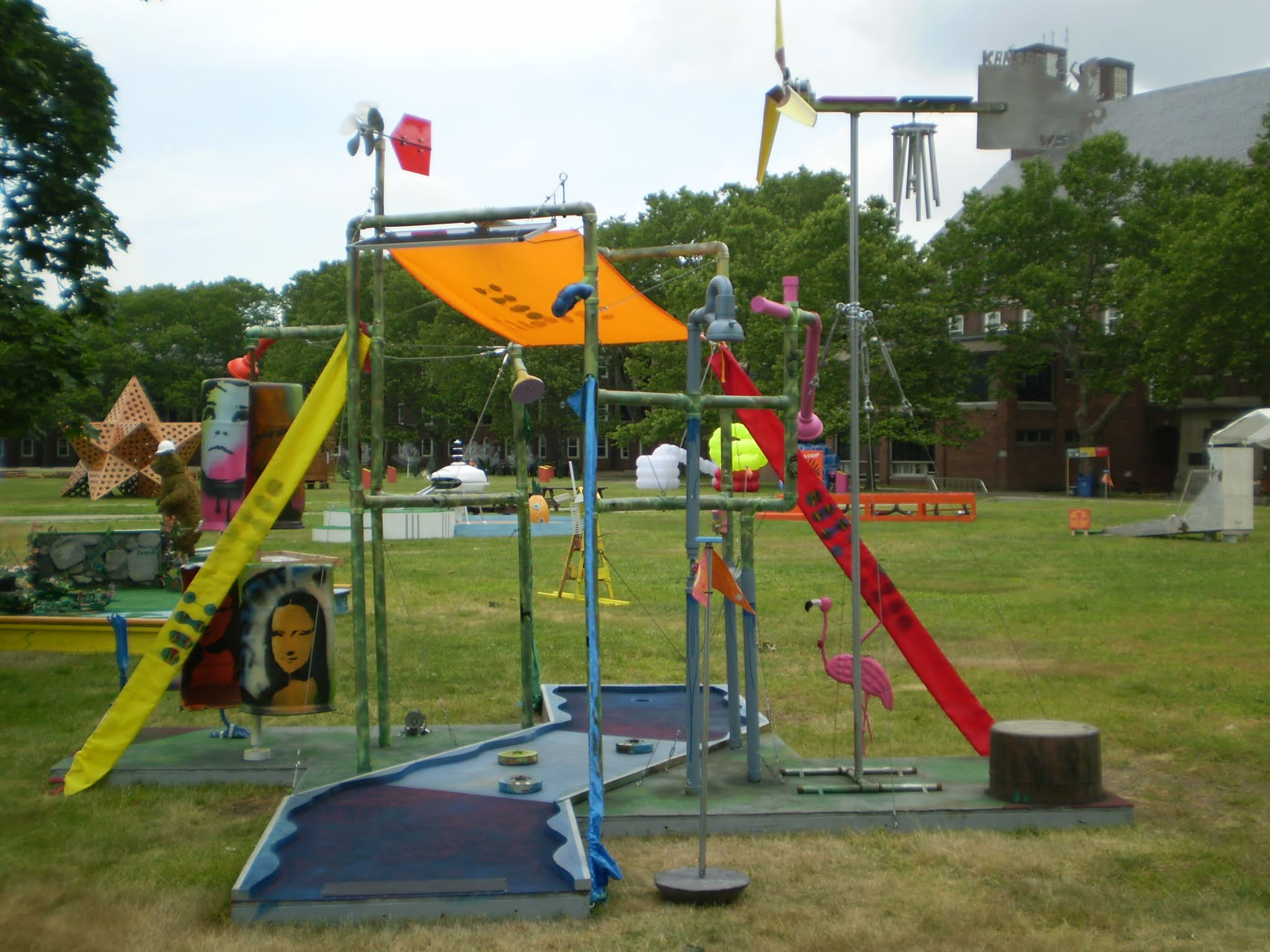
WSU’s mini-golf hole was chosen from a juried selection. Our hole contained multiple interactive elements, all powered by sustainable energy (wind and solar). As part of the mini-golf course it was well-received, entertaining over 250,000 visitors through the course of the summer.
Similar Posts

  • Assembly Language Programming

    In the Spring of 2008 I taught Wichita State University’s Assembly Language Programming for Engineers course. As explained in the syllabus, the course used the Z80 microprocessor and the GameBoy platform to introduce general concepts of computer architecture, machine and assembly language programming. Students practiced the ideas and concepts introduced in the course with programming…

  • TV Mountain

    TV Mountain is an art piece which was initially installed as part of TechArtICT’s Dreamgrass installation at Exploration Place Fall 2022. It consisted of 12 TVs at various angles and orientations, together forming a jumbotron. As part of Dreamgrass, it subjected faceless child-like objects to a litany of 80s commercials. The working remote enjoyed a…

  • Touch #1

    In 2012 I created my first interactive touch wall: Touch #1. The work built on my experience creating the visuals for Still Life and was largely inspired by seeing autistic children experiencing pure joy while interacting in an immersive environment. Touch #1 received a great response and was later installed at Exploration Place and at…

  • Ghost in the Machine

    Originally conceived in 2008, Ghost in the Machine (GITM) consists of a webcam and display which mixes and crossfades events in realtime with motion-activated video it has recorded previously. It continually shifts between 3 states: individual, community, and the world. GITM has been shown in many venues and contexts.

  • Microphone with proximity detection

    Around 2004 I developed a few protoype microphones enhanced to also offer proximity detection. The microphone could adjust it’s amplitude and bass response based on the proximity of the person using it. This would lessen the variable results users experience when holding a microphone too close or too far. Moreover, with proximity or its derivative mapped to a combination…